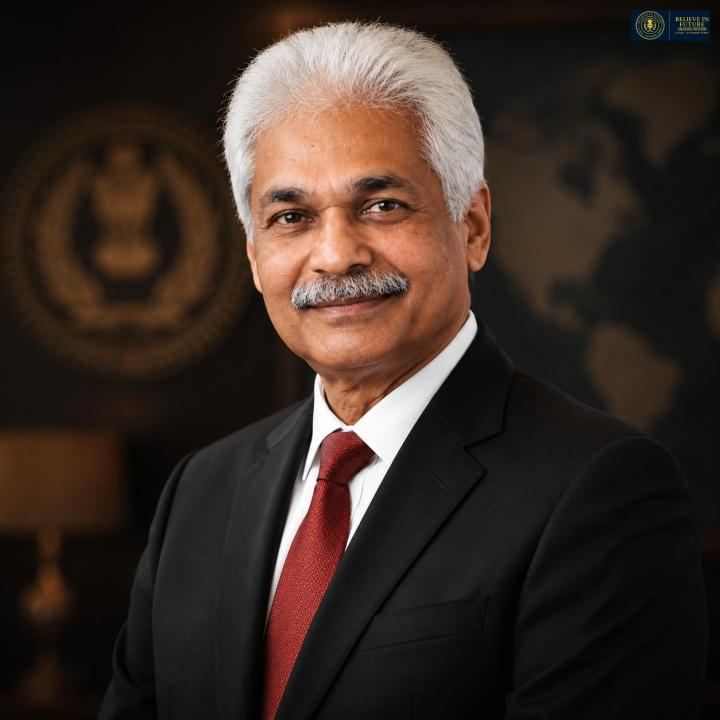
SEGMENT 1
BEFORE THE UNIFORM
Tone: Reflective · Personal · Warm
Music transition: Soft piano with a faint tanpura texture. Fade under the first question.
HOST OPENING
Your public journey appears highly structured—engineering, management, law, policing and public life.
But human journeys are rarely as organised as their biographies make them look.
Let us go back to the beginning.
QUESTION 1 — THE CHILDHOOD FOUNDATION
GAURAV — softly:
You grew up in a family of educators.
What did your parents teach you about dignity, discipline and service before you understood those words professionally?
Follow-up prompt:
Was there a particular sentence from either of your parents that still returns to you during difficult decisions?
QUESTION 2 — ENGINEER, MANAGER OR OFFICER?
You studied engineering at NIT Warangal and management at IIM Ahmedabad.
Those qualifications could have led to a very different life.
Why did public service become more attractive than corporate success?
[Pause.]
Was the decision driven by ambition, idealism, circumstance—or something more personal?
QUESTION 3 — THE DEFINING MOMENT
Take us to the first moment when you felt:
“My decisions can directly affect another person’s safety, freedom or future.”
Where were you?
What happened?
And how did that moment change you?
Story prompt: Encourage one early-field posting story.
QUESTION 4 — THE FIRST DISILLUSIONMENT
Many young people enter public service with a heroic image of changing the system.
What was the first experience that broke that illusion for you?
And after seeing bureaucracy, political pressure or institutional resistance closely—
why did you choose to stay rather than become cynical?
QUESTION 5 — THE PRIVATE COST
Behind every long public career, there is usually a family that lives with transfers, danger, absence and uncertainty.
What did your family sacrifice for your career that the public never saw?
[Allow silence.]
Was there a family moment you missed that you still regret?
HOST REFLECTION
GAURAV — gently:
Public biographies record appointments.
They rarely record absences.
And sometimes the cost of service is paid quietly by people whose names never appear in the official file.
MUSIC: Two-second reflective rise, then transition.
SEGMENT 2
COMMAND WITHOUT CRUELTY
Tone: Intense · Honest · Human
Sound design: Low percussion. A restrained heartbeat enters, then fades.
HOST OPENING
A police officer is expected to control disorder.
But many forms of violence are born long before the weapon appears—
through exclusion, exploitation, humiliation and lost opportunity.
Your professional record describes both armed operations and programmes designed around surrender, rehabilitation and socioeconomic intervention.
That creates a difficult question:
Can the state remain strong without losing its humanity?
QUESTION 1 — THE HUMAN BEHIND THE THREAT
When you were working in areas affected by insurgency, how did you train yourself to distinguish between:
a committed violent actor,
a frightened recruit,
and a young person pulled into conflict by poverty or coercion?
[Pause for reflection.]
Tell us about one person you initially saw as a threat—but later understood as a human being.
QUESTION 2 — FORCE VERSUS REHABILITATION
Your professional account describes medical outreach, surrender and rehabilitation initiatives alongside conventional security operations.
Was there resistance from within the police establishment to this approach?
Did some colleagues believe compassion would be interpreted as weakness?
And how did you defend your strategy?
QUESTION 3 — THE MORAL LINE
Every security operation involves incomplete information.
How does a commanding officer make a decision when waiting may endanger the police—
but acting too quickly may endanger an innocent person?
Is there a moral test you used before authorising serious action?
Human moment prompt:
Was there ever a decision that was legally defensible but emotionally difficult to live with?
QUESTION 4 — INVESTIGATION WITHOUT PREJUDGMENT
You later supervised complex CID investigations, including examination-related fraud, financial schemes and other high-profile cases.
In a politically charged or media-heavy case, how does an investigator protect the evidence from three pressures:
public anger,
political expectation,
and personal assumption?
What is the difference between pursuing the truth and merely building a case?
QUESTION 5 — TRAFFICKING AND INVISIBLE VICTIMS
Your research on trafficking examined the connection between vulnerability, education and exploitation, and you later authored Trafficking in Persons – Tip of the Iceberg.
What did survivors teach you that police files could never teach?
And what do governments still misunderstand about trafficking when they treat it only as a crime-control problem?
QUESTION 6 — WHAT THE UNIFORM DOES TO THE MIND
Police officers repeatedly witness violence, grief, manipulation and human cruelty.
How did that exposure change your view of people?
Did it make you more suspicious—
or more compassionate?
And what should police institutions do about the psychological health of officers who are expected to remain strong every day?
HOST REFLECTION
GAURAV — measured:
Perhaps the real test of authority is not whether it can defeat an opponent.
It is whether it can prevent another generation from becoming one.
MUSIC: Percussion resolves into warmer strings.
SEGMENT 3
SYSTEMS THAT OUTLIVE THE OFFICER
Tone: Analytical · Constructive · Future-facing
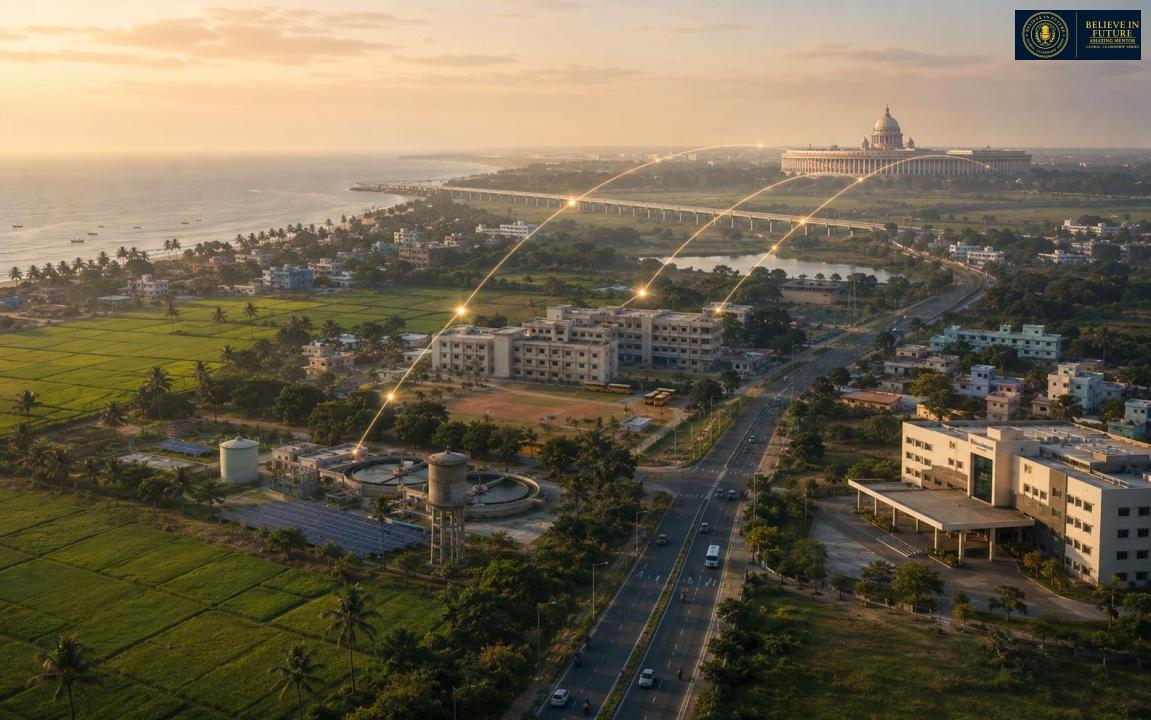
Visual transition: Archival-style imagery of police records changing into digital screens, roads, ports, classrooms and small enterprises.
HOST OPENING
Individual courage can solve one crisis.
But only systems can prevent the next one.
Your career moved beyond conventional policing into technology, infrastructure, road safety, economic empowerment and institutional design.
QUESTION 1 — DIGITISING THE POLICE
Your professional CV states that, while working in police computer services, you helped bring 1,865 police stations in undivided Andhra Pradesh online and participated in the technical process associated with the Crime and Criminal Tracking Network and Systems.
What was the real obstacle?
Was it technology—
or convincing people to change how they worked?
Follow-up:
What mistake do governments make when they believe digitisation automatically creates transparency?
QUESTION 2 — TECHNOLOGY AND CIVIL LIBERTIES
Digital policing can improve coordination and evidence management.
It can also increase surveillance, profiling and misuse of personal information.
Where should the line be drawn?
Who should watch the systems that watch citizens?
And do you believe India’s accountability mechanisms are keeping pace with policing technology?
QUESTION 3 — BUILDING INFRASTRUCTURE
Your CV records your participation through APIIC in projects associated with Hyderabad’s airport, HITEC City, the Financial District, convention facilities and port development, along with policy and public-private-partnership work.
Large projects are often celebrated after completion.
But during development, they involve land, finance, political disagreement and public resistance.
What was the most difficult trade-off you encountered between speed and fairness?
Lesson prompt:
What should young administrators know before signing a file that affects land or livelihoods?
QUESTION 4 — ROAD SAFETY AS GOVERNANCE
You have worked on state and national road-safety planning.
Yet road deaths are often discussed as isolated “accidents” rather than failures of design, enforcement, emergency response and behaviour.
What would you change first if you had complete authority over road safety for five years?
And which popular solution sounds effective but produces little real impact?
QUESTION 5 — SKILLS, DIGNITY AND ECONOMIC POWER
Your work with leather artisans and later social initiatives centred on skilling, enterprise creation and economic empowerment rather than charity alone.
Why is access to a livelihood often more transformative than access to a subsidy?
And what did working with marginalised artisans teach you about the distance between a government scheme on paper and dignity in real life?
QUESTION 6 — WHEN A SYSTEM FAILS AFTER YOU LEAVE
Have you ever built a programme that weakened after your transfer or departure?
[Pause.]
What did that failure teach you?
How can leaders create institutions that survive without their personality, authority or personal network?
HOST REFLECTION
A leader’s photograph may remain on a wall.
But the real legacy is what continues working after the leader is no longer in the room.
MUSIC: Purposeful electronic rhythm enters briefly and fades.
SEGMENT 4
THE CHAIR, THE PARTY AND THE PUBLIC
Required: Controversy & Clarity
Tone: Direct · Balanced · Respectful but unscripted
Music: No background music during the main questions. Let the conversation feel exposed and real.
HOST OPENING
Sir, leadership cannot be examined only through achievements.
It must also be examined through disagreement.
You spent decades as a career officer, where political neutrality is a central professional expectation.
You then entered party politics and became an elected representative.
That transition deserves a direct conversation.
QUESTION 1 — FROM NEUTRALITY TO PARTY POLITICS
What changed within you when you moved from serving governments of different political colours to publicly representing one political party?
Critics may ask whether a former senior officer carries administrative authority into electoral politics.
How do you answer the concern that voters may struggle to separate the former officer from the present politician?
QUESTION 2 — COMMAND VERSUS CONSENSUS
In policing, an instruction may need to be followed immediately.
In democracy, even an unreasonable voice has the right to challenge authority.
Did your command-oriented training ever become a disadvantage in politics?
Have you had to unlearn the instinct to control the room?
QUESTION 3 — THE 2026 LOK SABHA DISRUPTION
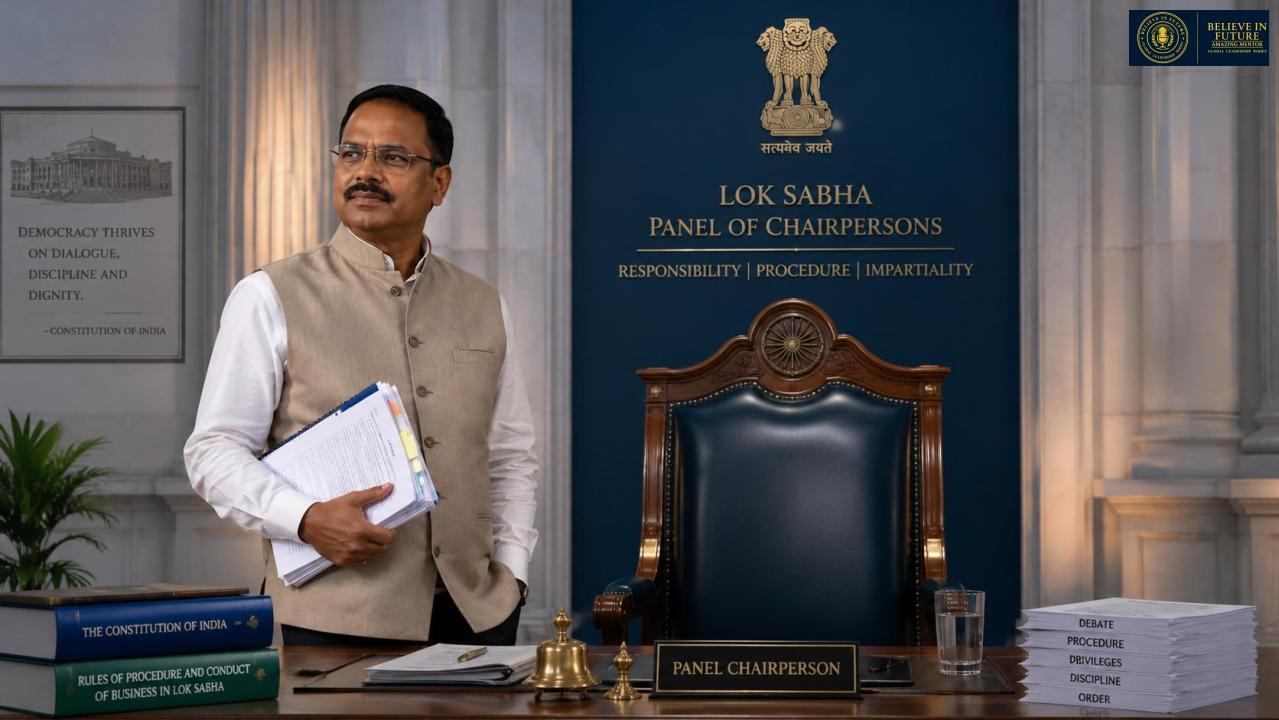
In February 2026, while you were presiding over the Lok Sabha, proceedings descended into disorder and eight opposition MPs were suspended after papers were thrown towards the Chair. You later objected to being addressed informally as “yaar” and said the dignity of the Chair had been crossed. Opposition members, however, argued that the disruption followed restrictions on the Leader of the Opposition’s speech.
GAURAV — calm, direct:
When you look back at that episode, what do you believe the public did not understand?
Was it primarily a breakdown of decorum—
or a deeper breakdown of trust between the Chair and the opposition?
QUESTION 4 — DECORUM OR DISSENT?
There is a difficult democratic tension here.
If the Chair tolerates disorder, Parliament may become unworkable.
But if the Chair interprets every disruption as indiscipline, legitimate dissent may be weakened.
Where exactly do you draw the line?
And should suspension be the final option rather than the immediate institutional response?
QUESTION 5 — EQUAL RULES FOR ALL
In December 2025, another reported exchange occurred when Union Minister Anupriya Patel continued beyond her allocated time while you were presiding, leading to repeated interventions and her microphone being switched off.
Does enforcing the rule against someone aligned with the governing coalition become politically harder?
What safeguards help a presiding officer remain fair—not only in intention, but also in public perception?
QUESTION 6 — THE CRITICISM THAT HURT
What is the strongest criticism of you that contained at least some truth?
[Do not rescue the silence.]
And did that criticism change your behaviour—
or only make you more determined to defend yourself?
HOST BRIDGE
Thank you for answering that directly.
Democracy does not become stronger when leaders avoid difficult questions.
It becomes stronger when power is willing to explain itself.
MUSIC: A restrained hopeful note enters.
SEGMENT 5
MENTORING THE REPUBLIC
Required: Advice & Mentorship
Tone: Practical · Honest · Encouraging
HOST OPENING
Thousands of young Indians want to become officers, entrepreneurs, public leaders or elected representatives.
But many are attracted first to the visibility of leadership—
and only later discover its responsibility.
Let us make this segment practical.
QUESTION 1 — ADVICE TO CIVIL-SERVICE ASPIRANTS
What should a UPSC aspirant understand before spending years preparing for the examination?
Who should not enter the civil services—even if they are academically capable of clearing the exam?
QUESTION 2 — THE FIRST FIVE YEARS
What should a young officer focus on during the first five years?
Building expertise?
Building relationships?
Protecting integrity?
Or learning how power actually moves?
What early-career mistake creates long-term damage?
QUESTION 3 — POLITICAL PRESSURE
Suppose a young officer receives an instruction that is technically possible but ethically questionable.
What should that officer do in the first hour?
Document it?
Seek written instructions?
Consult a senior?
Refuse?
What is the difference between courage and reckless confrontation?
QUESTION 4 — LEADERSHIP WITHOUT POSITION
Many young people say:
“Once I receive authority, I will create change.”
What can they start doing before they have a title, budget or team?
Tell us about someone with very little formal power who nevertheless demonstrated real leadership to you.
QUESTION 5 — FAILURE AND RECOVERY
What was a professional failure that improved you more than any award?
How did you recover without blaming the system, your colleagues or circumstances?
QUESTION 6 — THE MENTOR’S FORMULA
Complete this leadership formula:
Competence without character becomes…
Character without courage becomes…
Courage without wisdom becomes…
And what do we get when all four—competence, character, courage and wisdom—come together?
HOST REFLECTION
Young leaders do not need another motivational slogan.
They need tested principles—
especially for the days when doing the right thing carries a price.
SEGMENT 6
BEYOND RANK — TRUTH & DARE
Required Rapid Fire
Tone: Playful · Personal · Revealing
Music: Light rhythmic percussion with a subtle ticking beat.
HOST SET-UP
Sir, we have spoken about policing, Parliament, policy and leadership.
Now we remove the résumé.
This is Truth & Dare.
Short answers.
No official briefing.
And ideally—no diplomatic escape.
[Smiling tone.]
Ready?
RAPID FIRE
1. Truth:
Which is more difficult to manage—armed personnel, senior bureaucrats or politicians?
2. Truth:
One habit from police service that your family wishes you would finally abandon?
3. Truth:
Are you naturally patient—or have you simply learned to appear patient?
4. Truth:
What makes you lose your temper fastest?
5. Truth:
A decision you defended publicly but questioned privately?
6. Choice:
A perfectly disciplined meeting or a chaotic meeting that produces one brilliant idea?
7. Choice:
Field intelligence or data analytics?
8. Choice:
A powerful speech or a quietly implemented policy?
9. Finish the sentence:
“Power reveals…”
10. Finish the sentence:
“The biggest lie leaders tell themselves is…”
DARE 1 — THE YOUNGER SELF
GAURAV:
Look into that camera.
You have twenty seconds.
Speak directly to the young Krishna Prasad on the day he first put on the uniform.
Tell him what nobody else had the courage to tell him.
[Music drops. Hold close-up.]
DARE 2 — THE APOLOGY
Without naming the person, is there someone from your public or personal life to whom you still owe an apology?
What would you say?
[Allow a genuine pause.]
FINAL RAPID-FIRE QUESTION
What is one thing people assume about you that is completely wrong?
HOST RESPONSE
That may be the most revealing answer of the episode.
MUSIC: Warm, playful resolution.
SEGMENT 7
INDIA 2047 — FROM POPULATION TO POSSIBILITY
Tone: Visionary · Expansive · Hopeful
Music: Soft piano begins, followed by slowly rising strings.
HOST OPENING
Your parliamentary work has covered subjects including education, healthcare, water, infrastructure, skills, social justice, technology and regional development. As of April 2026, PRS recorded 91% attendance, 24 debate interventions, 178 questions and two private members’ bills during your first term.
Let us move beyond today’s headlines.
Let us imagine the India the next generation will inherit.
QUESTION 1 — THE REAL NATIONAL EMERGENCY
When you look twenty years ahead, what worries you most?
Unemployment?
Institutional distrust?
Climate pressure?
Social division?
Technological displacement?
Or something we are still failing to recognise?
QUESTION 2 — SKILLING OR CREDENTIALS?
India has millions of degree-holders, but employers still speak about serious capability gaps.
What must change in the relationship between schools, universities, skills and employment?
Should success be measured by certificates—
or by the number of people able to create value independently?
QUESTION 3 — AI, POLICING AND GOVERNANCE
Artificial intelligence will increasingly influence policing, welfare delivery, recruitment, surveillance and public decision-making.
What should machines never be allowed to decide without meaningful human accountability?
And how do we prevent technological efficiency from becoming institutional cruelty?
QUESTION 4 — THE FUTURE OF DEMOCRATIC DEBATE
Do you believe the next generation will have greater faith in Parliament than the present generation?
What must elected representatives change so that disagreement appears productive rather than performative?
QUESTION 5 — ONE REFORM
Suppose you could implement only one national reform—
and you would not personally receive any credit for it.
What would you choose?
Why that reform?
And how would it change the life of an ordinary citizen?
QUESTION 6 — HOPE
After witnessing crime, conflict, institutional failure, poverty, political confrontation and public expectation—
what still gives you hope?
Is your belief in the future based on evidence—
or is hope itself a discipline?
Sir, before we conclude, I would like to ask you the question we ask every Amazing Mentor.
[Pause. Direct eye contact.]
“What message would you like to leave for the next generation?”